Ben Lerner Speaks to the Dead
Ben Lerner and Alexandra Schwartz at Pioneer Works, 2026.
Photo: Walter WlodarczykBen Lerner’s new novel is filled with silences: factual and dramatic lacunae; conversations in which one participant seems to be all but missing; hinted-at mysteries that go unsolved. This is particularly striking because the premise of Transcription’s action is speech. As the book begins, Lerner’s unnamed, first-person protagonist—a familiar one for his readers, who are used to encountering the writer’s alter ego in his prose—is traveling to Providence, Rhode Island to conduct an interview with his mentor, a polymath professor at Brown University named Thomas. The narrator is in the middle of his life. Thomas is nearing the end of his. The premise of the interview is that it will be his last, an important record for future generations. Then, in his hotel room, the narrator drops his phone in a sink full of water, breaking it. He can’t record the conversation—and somehow can’t admit this to his interlocutor, even as he sits in Thomas’s living room, listening to him recount his earliest memories, pretending that nothing is amiss.
In short, the narrator lies. Someone always does, in a Lerner novel; lying is one of his great subjects. In his first novel, Leaving the Atocha Station, the narrator, Adam Gordon, wrings sympathy from a romantic interest by telling her that his totally healthy mother is dead. In The Topeka School, we meet the same character during his adolescence as a champion debater, so skilled at taking any position on a given topic that facts twist and turn upon themselves, flexible and weightless. “The lie described my life better than the truth,” a character says in 10:04. The narrator of Transcription might claim something similar. When it is revealed, in the novel’s middle section, that the conversation that has been published as Thomas’s last was, in fact, recreated from his own memory, people are furious at having been misled. The narrator is indignant. Yes, their conversation is a fiction, an imagined representation of the ineffable real, but it has captured reality better than any recording could.
I have always loved the intelligence and irony of Lerner’s novels. Transcription has those qualities, but it has something else, too: a disarming sincerity. Lerner’s narrator is gentler than his previous incarnations, if no less confused by life’s puzzles. How do we care for a child who refuses our care? Why do we fail the people we love, and how do we love the people who have failed us? What does it mean to live alongside digital devices that ceaselessly demand our attention? The book is short enough to read in a single sitting, which I did, twice, surrendering to the music of its various voices. That’s by design. The novel, as Lerner said to me on stage at Pioneer Works, is its own kind of technology, and a powerfully transportive one. For better or worse, our conversation has not been recreated from memory, but transcribed (with light edits) exactly as it happened.
—Alexandra Schwartz
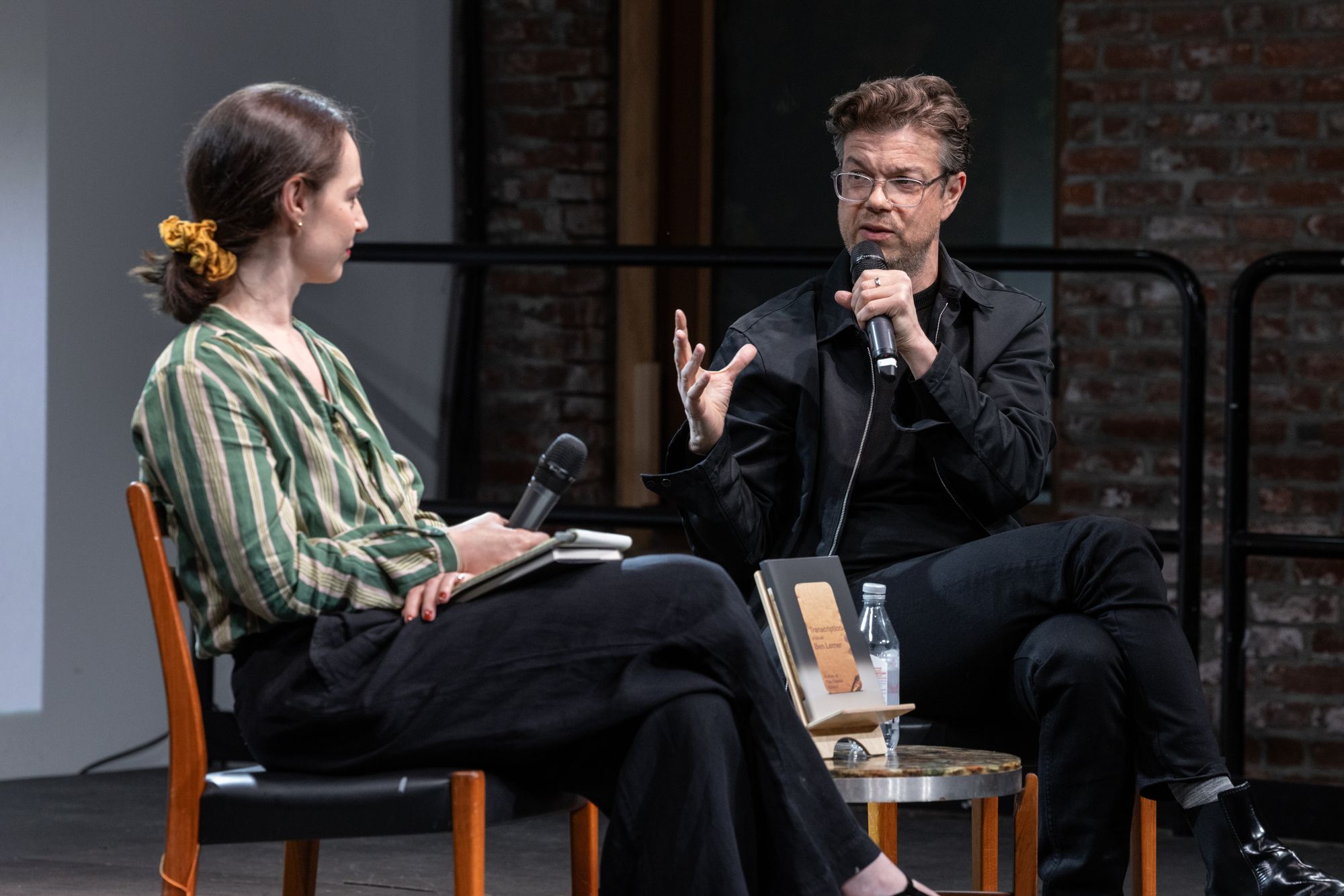
Alexandra Schwartz and Ben Lerner at Pioneer Works, 2026.
Photo: Walter WlodarczykWhen we were emailing very briefly about this event, you called Transcription a weird book. I want to know what is weird about it to you.
I mean, I think it's weird for me because my memory of writing it is a little dreamlike. The book is about dreams, in part. And Thomas, the crucial character in the book, has this line about how waking does not finish a dream.
Part of what the book is about, maybe, is the contagion of Thomas's voice—that the characters start speaking in his voice or that his voice speaks through them. And when I try to talk about it, sometimes I feel like I'm channeling semi-fictional characters.
I wanted to write a really short book that kicked out a lot of issues, but had a lot of felt silence and weird angles. I wanted it to be more haunting than explanatory. And I think “weird” is a word I associate with the uncanny or the haunting or the doubling or the repetitions that happen.
I'm glad you say that because I thought about the “weird” that exists in the American vernacular, where everything can be weird—a word that can kind of come in when you don't have another word. But I also thought about this haunting and incantatory effect that I think this book has.
In the opening scene, the narrator is on a train and he's facing backwards, or what his daughter calls “the past.” He's facing the past because he's returning to Brown, his alma mater, and has the feeling that a younger version of himself could still be there, existing in a parallel reality. This book bridges the narrator's current middle-aged world, as you say, with this college world. What drew you back into that past?
That's an interesting question. Part of it is just the power of mentorship. I had influential teachers, but college was the first time where there were people who seemed like they might be channeling voices of the dead. It was the first place I was really thinking about intergenerational artistic transmission. And also where I encountered people who just had capacities for attention and reading that were totally otherworldly to me, like Keith and Rosemarie Waldrop. These people introduced me to deeper relationships with media, with the book as a form, or the painting as a form, or whatever. And college was also very formative in all kinds of other ways, as it is for everyone—it's where I met my wife.
I was also thinking about the similarities and differences between mentorship and fatherhood. The narrator of this book describes having a very serious, nervous, maybe psychotic breakdown in college. He starts hearing voices, and Thomas, his mentor in the arts, helps him move on from that experience and offers a kind of care that he never offered his own son. The narrator loses his mind and gets it back and it’s all caught up in art, or how art can channel forces from different times and make them feel present.
There is a sense, because you bridge this time in the novel between the present and the past, that the narrator has made it through. He can look back at the terror of that time of total disorientation, and he's made it through to the other shore.
You can't choose your parents, which I think many of us feel enraged by. But when you're a parent, you also know you can't choose your kids. Maybe Thomas tries to choose, in his way of mentoring.
Yeah, I think he does. I knew a lot of people who lost their purchase on reality in college, and some didn't make it. It had to do with many things, and they were always individual, but mainly: you're away from home, you're exposed to a whole lot of new languages, and you're either finding the self you already are or constructing a whole new self. It's quite confusing.
In the moment where the narrator has his most serious, pathological break with reality, Thomas opens up the possibility of redescribing the reel as a fiction, as a changeable fiction. And so there's a way that this moment of artistic encounter is intimately related with one of psychotic collapse. And the way that Thomas helps him is by playing an auditory illusion, which the narrator calls “art therapy.”
Basically, if you listen to a vocal track, and then convert it to a MIDI file so it all becomes flattened into computer piano notes, you’ll still hear the voice, even if it isn’t there anymore. Your brain assumes that the voice is present, and you unconsciously infer it. Thomas plays this for the narrator to normalize and socialize his experience of aberrance. He means to say something like, “See, we can all hallucinate and have auditory illusions in the right context. It’s just a question of the conditions.”
A lot of my life is organized around the idea that there’s something really important about imagination’s capacity to redescribe reality. It’s also a horrifying capacity, because it shares a wall with psychosis. And I think that’s part of what’s happening in college. I don’t know if that’s an advertisement for college or a reason to avoid it.
I think that's so true. In fiction, writers remake the world and sometimes they want to make it totally unrecognizable. In college, the same thing is happening—there are exceptions, but most people who go have never had the independence to create a life. And so there you are, doing fiction that's actually real. You're a character who's real.
I want to ask you about Thomas. Talk about the MIDI illusion, you can really hear his voice in your head as a reader. It's very distinctive. It has a German inflection, and that amazing grammar where there's total fluency in English, but something magical about how the speaking happens because it's not totally idiomatic English. Who went into making that character?
I mean, the voice is really Alexander Kluge's voice. It's his English. He died a few weeks ago, and he was a hero of mine. He was Adorno's favorite son. I don't know when he became a lawyer, but he was the lawyer for the Frankfurt School. And he was this major philosopher and filmmaker who studied film with Fritz Lang. When he spoke, it was this weird mixture of erudition and prose poetry, and you couldn't quite tell what was fabricated and what was the fruit of his bizarre archival research. It was really exciting to be around him. None of the familial stuff bears any resemblance to Alexander Kluge, and I didn't know him in college, but the voice is his voice.
How did you get it? Did you have it in your head already? Were you watching videos, or listening to your own recordings of conversations with him?
That voice is just really in my head. I often have trouble recalling voices. Some people really feel like they hear a voice as a material sonic event, and I don't. When I say I hear a voice, I mean the way I hear something when I read. I'm aware of the sonic shape, but there's no sound, though Alexander Kluge's voice is one I actually can kind of hear. So it was just really available to me.
And why did you want to put your narrator in a situation where he would not be able to capture that voice on tape, where there was going to be no way to have a technological record of this conversation? What about that scenario appealed to you?
One thing that I've noticed in almost all my writing is that the dialogue tends to operate under the sign of something that destabilizes its claim to realism. I think dialogue for me has always been this really interesting problem because it's the biggest mimetic claim in fiction. You aim to just write down what people say, but of course, usually what happens is it's really cleaned up and can feel quite artificial—sometimes to great effect, like the way that Ivy Compton-Burnett's characters speak in these perfect, mean English sentences. There are other experiments in depicting all the fragmentation and incoherence of how speech usually functions. And neither of those work for me exactly.
This is a long-winded way of saying that I think in each book I've written, there's some way that dialogue can happen and also be destabilized at once. That's a condition of my being able to write. So to be able to write Thomas's voice and say, "There's no record of this," was just enabling for me as a condition.
On the one hand, the narrator has made it up or reconstructed it from memory, but on the other, it's a testament to the power of Thomas's voice that it could be reconstructed and passed through the narrator. This is a book, in part, that tries to establish a relationship between media like phones, or radio, or cinema, with the way that the individual human is a medium: you speak through someone and not just to someone. And there are specific perils or potentials of transcription when it's a human doing the writing and the voice that's being transcribed is resonating with the particular stuff of that human.
Not having that technological recording was a way to let me write dialogue, and it also became a way of actually amplifying the power of Thomas's voice and how it travels. The voice is all the more powerful for not being captured by the phone, the way they capture those ghosts in Ghostbusters in that thing. Instead, the haunting happens because the voice is not in the thing, it's still in the people.
It reminds me of when I started reporting and I didn't know what I was doing, and I would just let my recorder run because I was so afraid of missing anything. And then when I listened back, I was always overwhelmed by the nothingness of what was happening. It was too much, and it required a human intelligence to decide when to click start and stop. It’s such a great moment when your narrator walks around the campus after dropping his phone in the water. He describes an unusual experience of presence, where he feels super charged by both the past and the present because he's not stopping to consult this device. Reading that, I thought, "I'm going to put my phone in that little box that they're always advertising to me on Instagram. I'm going to live my experience of unusual presence."
Later, I do think it becomes complicated that he doesn't have his phone. This book isn’t just a manifesto for screens down, unless I missed the message? Should everyone leave here thinking that Ben Lerner says, "Put your phones away"?
No. It would be a really boring book if I just said that phones are bad, because we know they’re bad. First of all, the narrator does have this reverie that's produced by being phoneless, and I think that's real, but by the time he gets to Thomas's house, he's having withdrawal symptoms.
The book is less about putting away media and more about what it would mean for us to restore our wonder before all the different kinds of media that there are, including people or glass flowers or other works of art. But it's unpredictable. In the third section of the book, there’s Thomas’s granddaughter, who has a very serious eating disorder. Her parents have been fighting one of these conventional parental battles about not eating in front of the screen, but then when they let her watch the iPad, she actually eats. Max, Thomas’s son and the girl’s father, is very disturbed by why it helps or why she needs it. But it's an unpredictable use of the screen that would be hard to say is just bad, even though she's watching unboxing videos, which scandalize her father and surely have their own consequences.
There's also this scene where Max thinks he's saying goodbye to his father. And this is when Thomas is hospitalized with COVID, which actually happens before the narrator visits him for that last interview which the book opens with. Max says all these meaningful things to Thomas that he would not have been able to say in his physical presence, nor on Zoom, which they first tried in the hospital.
When a nurse calls him on the phone, and he can be a disembodied voice, that mixture of distance and proximity allows a kind of intimacy that otherwise had never been available in their relationship, which is just to say that the book is not about how “technology is bad” or whatever. Yes, it is about the atomization and the destructiveness of all these things, but it's also about little pockets of possibility in media configurations that are difficult to foresee.
The book is divided into three parts. The first part is this visit that the narrator makes to Thomas's house. The middle part takes place in Madrid, where the narrator has given a talk after Thomas has died to a group of people who all knew him really well, and he’s confronted by the consequences of his decision to publish an interview that he didn't technically record. And the third part of the book is about Thomas's son, Max, who is a foil to the narrator. They both went to college together. They were friends in college. It's implied that they have not kept up their friendship, certainly not to the degree that they had when they were young. And Max has a really difficult relationship with Thomas, which is not that surprising—it's hard to be the son of a great man.
As I was reading the book, I wondered if you had even a physical shape in mind for its structure. I'm sure it wasn't the same for you, but it made me think of Virginia Woolf writing To the Lighthouse and drawing her “Time Passes” section as a little artery between these two bigger passages. And then I thought maybe the narrator is a phone, in a way. The book is a conversation between Thomas, who monologues in the first section, and Max, who monologues in the last section. In each case, the narrator is the interlocutor between them, but once you're out of his thoughts, you're not hearing his voice very much. They're speaking to each other through this human phone medium and their messages are not going to reach one another. They're just going to be stored in the person who's in between.
Is that a legitimate reading?
Really legitimate reading. There are other things too, but the narrator is primarily a medium. Thomas speaks to Max through the narrator. I mean, he also speaks to the narrator through Max.
And Thomas confuses the two of them in his mind.
Yeah. In the first section, Thomas is talking about ending his life and assisted suicide in a way that the narrator doesn't quite track. And so there's also this kind of specter of last words. But I think you're totally right, except for what you said about the messages never reaching each other.
I think Thomas is making a kind of contact at the very end of the book, even though he's dead. I think the book does believe in the idea that messages survive in the ether and might be received in unpredictable ways. Thomas's voice definitely survives his body in the book and goes on speaking through these other people.
Max says these hard things to Thomas when he thinks he’s dying, and then Thomas survives and doesn’t remember the conversation. But there are things that Thomas says in the first interview that imply that maybe he did register or transcribe aspects of the conversation, whether or not he remembers it consciously. I guess I'm just saying, I think you're absolutely right that the narrator is like a phone. And I think the book is kind of agnostic about whether those messages reach who they’re meant for.
Let's talk about the parenting aspect of the book a bit. Parenting has come up in all of your work, but never as explicitly as in Transcription. And we have three different models of parenting here. We have Thomas, the “great man,” who was not so hands-on. A lot of boarding school involved, a lot of family trauma that went unacknowledged, abandonment stuff. And then we have these two modern dads who really want to do right by their kids. Their kids' problems are really their problems. They each have one daughter, and both of their daughters are dealing with refusal. The first daughter of the narrator doesn't want to go to school, and it's a big drama in the narrator's life.
Every day is a real challenge. Is she going to go to school? Can we get her through the day? And then Max’s daughter, as you've said before, does not want to eat. It's not anorexia, it’s something else called ARFID, and it’s just a refusal to eat and not wanting to deal with food. Understandably, Max and his wife find this a totally harrowing and destabilizing experience.
Why did you write fathers of daughters? And why did you choose these particular conditions for the girls and their dads to confront?
This is a good question. Part of the daughters thing is a boring extratextual answer, because I have daughters. And then part of it is that I got interested in a book that was once about fathers and sons and fathers and daughters. I was interested in that difference, which I haven't seen represented so much. I mean, I'm sure there are lots of books that I'm not thinking of that do it. I don't mean to make a claim for its originality, but it felt like something new for me to think about.
On the question of those refusals, I've always been very drawn to the literature of non-participation. I mean, think about Bartleby or A Hunger Artist. They allow you to watch a world that's organized around growth and productivity collapse in the face of a refusal that it doesn't know how to assimilate. Literature itself is constructive and can intervene in situations, but it's also always caught up in the refusal of other kinds of discourse and other kinds of activities. So I became interested in these very contemporary conditions of refusal—both of which were apparently really accelerated by COVID, according to the psychologists I know—that bring out parental powerlessness like nothing else. When your kid won’t eat or won’t go to school, what do you do? Every parent has some version of that.
That refusal is at once very contemporary—linked to devices and screen time and Instagram and the deadening effects of Zoom—but then it's also very literary and mythic and ancient. When Max takes Emmy to meet a specialist, he says she looks like an angel, but he’s not happy about it. She looks so calm, like some emissary from another world who’s just kind of forgiving us because we don’t know what we’re doing. It's terrifying for him.
What you said about how the narrator and Max have ingested the problems of their girls and made them their own problems, that resonated with me. A lot of parenting is also figuring out that your kid can have a difficult time without you internalizing the intensity. There are more options than just the authoritative father and someone like Thomas, who, as the bad counterpart to his art therapy with the narrator, would just aestheticize Max’s experiences when his son needed support.
And there's also an intergenerational thing that's quiet. Max's mother killed herself, and so the battle over Emmy’s eating is also about Max's loss of his mother and his fury at Thomas for being totally absent in the wake of that suicide. That's the other thing about parenting: You're relating to your daughter, but you're also relating to the way you were raised. Different generations are speaking through you, or you’re speaking the things that you wish a parent had said. Things can get refracted in a strange way, or they have a misplaced intensity that the kid senses, so that you could be saying the right thing—and a transcript might show that you said the right thing—but the intonation is something else entirely.
What you're making me think of is how novels and parenting are both ancient forms that need to be revitalized and rediscovered and reinvented each time around. These are things that have to do with transcribing how life is, how people are, and how we relate to one another, but we have to find our way through and invent a new way each time, even though they've happened forever.
Parenting and novels are also two areas of life that people are really pessimistic about. And as this book documents, there are a lot of reasons not to want to engender life on earth.
You're a practicing novelist and a practicing parent. Are these things that you see in parallel? Do you have hopeful feelings about them, despite the discourse of decline?
I've thought a lot about how for thousands of years, there's been this proclamation of the death of poetry. There's been something productive about always claiming that the form is in crisis, because it’s allowed people to say something about society. So what I try to do is be more interested in what people are proclaiming, exactly, when the ones who claim to love novels are proclaiming that they’re dying. Are they saying that it's not the default mass cultural form? Are they saying it's in the hands of the wrong people? Or can they work their way to an argument about what new possibilities of the form might emerge?
I try to get interested in what the claim of decline is for, but I feel the assault on my capacity for attention and thought from a media configuration and from a political configuration. I feel it really intensely, and I do think one should be alarmed. But again, what are you going to do with the alarm? It's just not very interesting to despair.
I could stop writing novels, but it's too late to stop the parenting thing. My literary education was really invested in this modernist idea that your readers were displaced into the future, and you made your weird, complicated works of art that resisted the present because they were messages to the future. The future has never been assured, obviously, and the mind is always at the end of an era, but I don't really have an imagination of the readers of the future. It doesn't mean that they don't exist. I just mean that one way I register the pressure is that the modernist fantasy is much less available to me. And I think you have to always parent with the future "as if." Maybe that “as if” is part of the meeting place between parenting and literature, because it’s the technology of fiction. It doesn't really matter if there's a future, but you have to produce the fiction of one to live because it textures the present.
You mentioned at the very start of our conversation that you felt comfortable with leaving things unsaid in this book. And certainly as a reader, you sense things that belong to a deep underhistory of the book that you can’t totally access. You're a poet as well as a novelist, and some of what was unsaid reminded me of tendencies that exist maybe more so in poetry.
For a while the book had a long second section, and I kept thinking that the solution would be going deeper into experiences of Spain, and giving the narrator a different family relation. I thought there needed to be more of that, and that it demanded more writing. I don't think I've ever shot up in bed with an insight into writing, but I actually did shoot up. I was just like, "Oh, all of that has to go. I just have to cut all that.”
It can be hard if you've worked on something for a while to cut, because the problem wasn’t the sentences. It's easy to cut bad sentences. It was just that there was too much of the narrator, so it was getting in the way of that dynamic that you really eloquently described, which is actually the formal tension of the work.
I think the thing is kind of about resonance: the way a voice resonates in you or how an experience resonates. And that required the book to be more of an echo chamber than [something with] cascades of writing, even if the writing could be eloquent or whatever. Once I cut all that from the middle, then I could tune it. Lots of my readers—of course Mitzi, my wonderful editor, and Ariana and Anna—helped me with subtle modulations in the form that changed the resonance. So it was a different kind of instrument.
There's also a suspicion, in the book, of eloquence. Thomas is the great talker, but while that talk has beautiful effects and can cast spells, it can also be a technology of obfuscation. When I cut that middle section, I realized that I wanted a very short book because I wanted it to feel handheld in a different way, so that you really, in reading it, would be thinking about the embodied experience of being with this device in its codex form that is the book, and thinking about its relation to the phone and the other screens that are described within it.
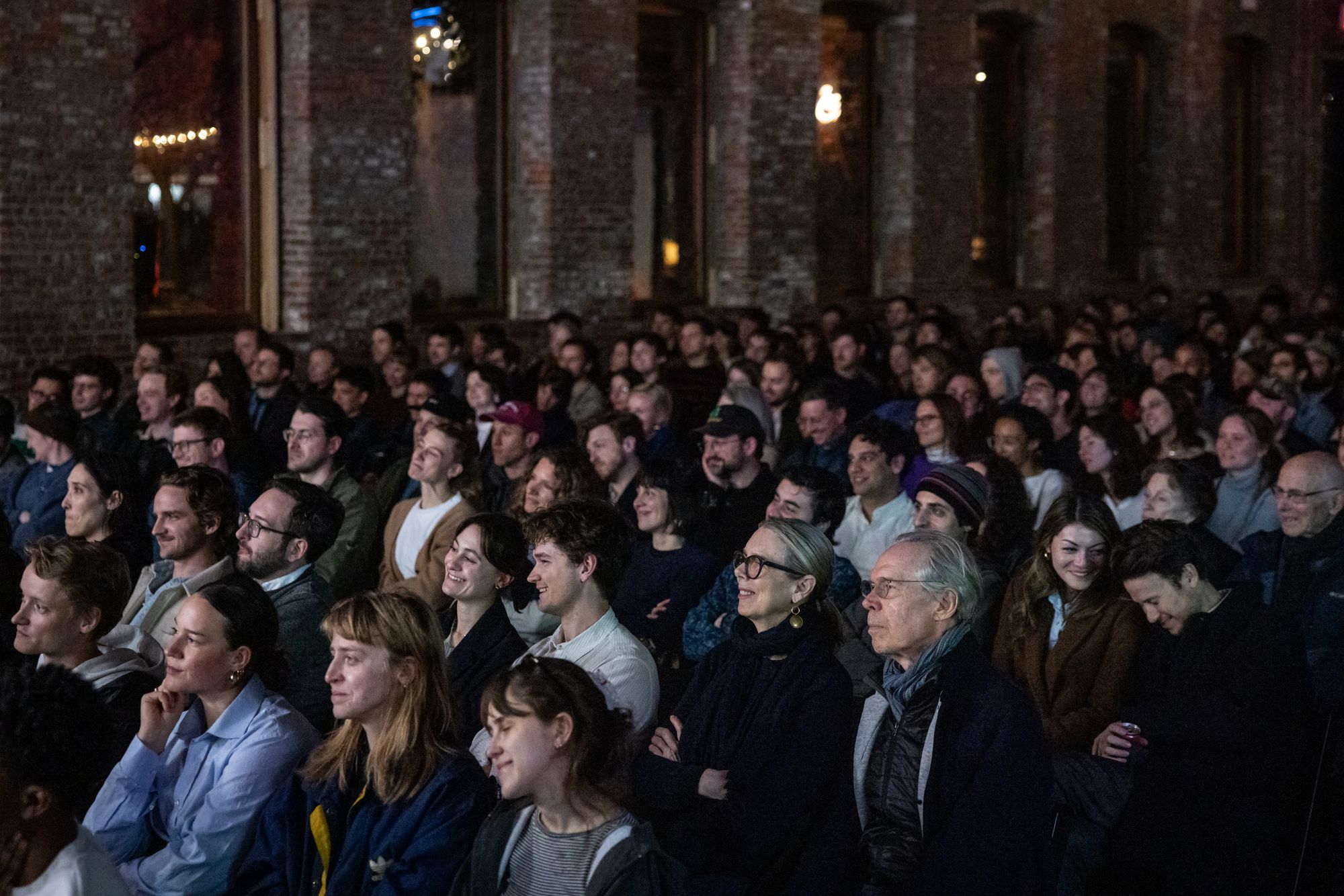
An adoring audience for Alexandra and Ben, 2026.
Photo: Walter WlodarczykI didn't know about the presence of this middle section, but when you cut it away, it is a lot like the MIDI experiment you describe, where actually the reader's mind fills things in. It's fascinating how the novel allows for the same kind of embodiment to take place, even if it's off the page.
In preparing for this and knowing how important Alexander Kluge was to you, I was watching a video of him interviewing Michael Haneke and saying, “What you don't see is what you imagine the most intensely.” That’s a rule of cinema, of course, but it turns out to be true here as well.
I want to come back to Alexander Kluge. Does it feel sad or surreal that you now have this record of his voice right after he's died and your book is coming out and you've recreated him for a lot of people in this very particular context?
Yeah. I mean, I have to say the whole way that I got to know him was so bizarre and lucky.
Tell.
Well, I had loved Kluge. He’s very well known in Germany, he has tons of great books, and I loved and admired him when I was writing my first book of poems, called The Lichtenberg Figures. I even had this fantasy that I would send the book to Kluge, but I didn't know how to send something to him. I wasn't even sure he was a real person because he just seemed like this whole ensemble of unlikely practices. So I didn't try to send it to Kluge, whatever that would've meant.
And then, 13 years later, I was looking through the spam folder of my Gmail because I had missed a work email. There was this message from one of these bizarre email addresses like kluge7000@aol.com and the subject heading was “From the desk of Alexander Kluge.” And what had happened was that my book had been published in this little German edition that was instantly out of print, and his friend and personal physician had given it to him—not because he was like, “You’ve got to read these poems, they’re so great,” but because Kluge collected anything that had the word “Lichtenberg” in it. And then this email from him, which had been dictated to his people, was like, “Dear Mr. Lerner, My personal physician has given me your book, and please find attached these 15 stories I have written in response to your poems."
So it was this totally message-in-a-bottle, charmed, crazy thing. And I'm one of a million people who've collaborated with Kluge, I don't have any particular claim, but he thought of me as young because he was old and also because he's like thousands of years old. We wrote a book together and made some other things. And so I wrote this in his voice and I was pretty sure he wouldn't feel upset [by the complications of that character], because he was not like that. Kluge had a different relation to everything. He just saw it from a distance. But I was worried because the book came out in Germany at the same time and people were speculating about what was real. I wrote to him and said that the voice is an homage to his voice, and Thomas's work is an homage to his work, but obviously the rest is fiction. And he wrote this really beautiful note that said it was a poetical portrait of his voice, about me and not just about him. It was this really loving exchange that I felt great about. And then he died and someone told me it was the last book he read. I feel very lucky that I had his blessing.
I do want to be clear that the relationship with the son is all fiction, and parts of him are a composite of other people like Rosemarie Waldrop, who's alive and well. I interviewed Rosemarie for The Paris Review, and that was a big part of the genesis of this book. She also talks about one of her first aural memories, hearing Hitler on the radio. So Thomas is all these people who have mattered to me, but also who brought me the dead. I got Stein through Rosemarie, and though he wasn't dead at the time, I got Creely through her, too.
It's about transmission and all these voices coming through. I got so many things from our conversation, Ben, but one very practical thing that I'm going to take is always to check your spam folder. ♦
Subscribe to Broadcast