Daylight Came
An outtake from Harry Belafonte's album cover for Calypso, c. 1956.
Courtesy of Getty ImagesThe idea arose suddenly. In the summer of 1955, Harry Belafonte—a Harlem-born son of Caribbean immigrants who’d begun his performing career as an actor, but whose star was now rising fast as a singer—was 28 years old. He’d caught the theatre bug in his teens in Harlem and dabbled as a jazz crooner. But then he’d found his métier, in the early ’50s and down in Greenwich Village, in the folk music scene whose paragons––Pete Seeger, Woody Guthrie—extolled the dusty music of common people. Belafonte was a decidedly un-dusty thespian who sang songs from America’s backwoods and around the world, not sitting on a stool but standing up. He would famously turn these melodies into glamorous modern pop.
Tellingly, Harry’s big break had occurred not in one of the Village clubs where he’d honed his act but on Broadway, in a revue-style show wherein dramatic renditions of Mississippi riverboat songs convinced executives at RCA Victor to sign him to their label as a recording artist. They thought his folk act might lend itself extra well to a new format—the 33 ⅓ long-playing record they were pressing on consumers. His star turn in John Murray Anderson’s Almanac also saw him cast, in 1954, in Hollywood’s first-ever blockbuster to feature an all-Black cast, Carmen Jones. And now, just as the telegenic star was seeking ideas for his new record, he received a fateful invitation. Producers at NBC wondered: would he like to produce and perform in a special guest segment on the network’s Colgate Comedy Hour?
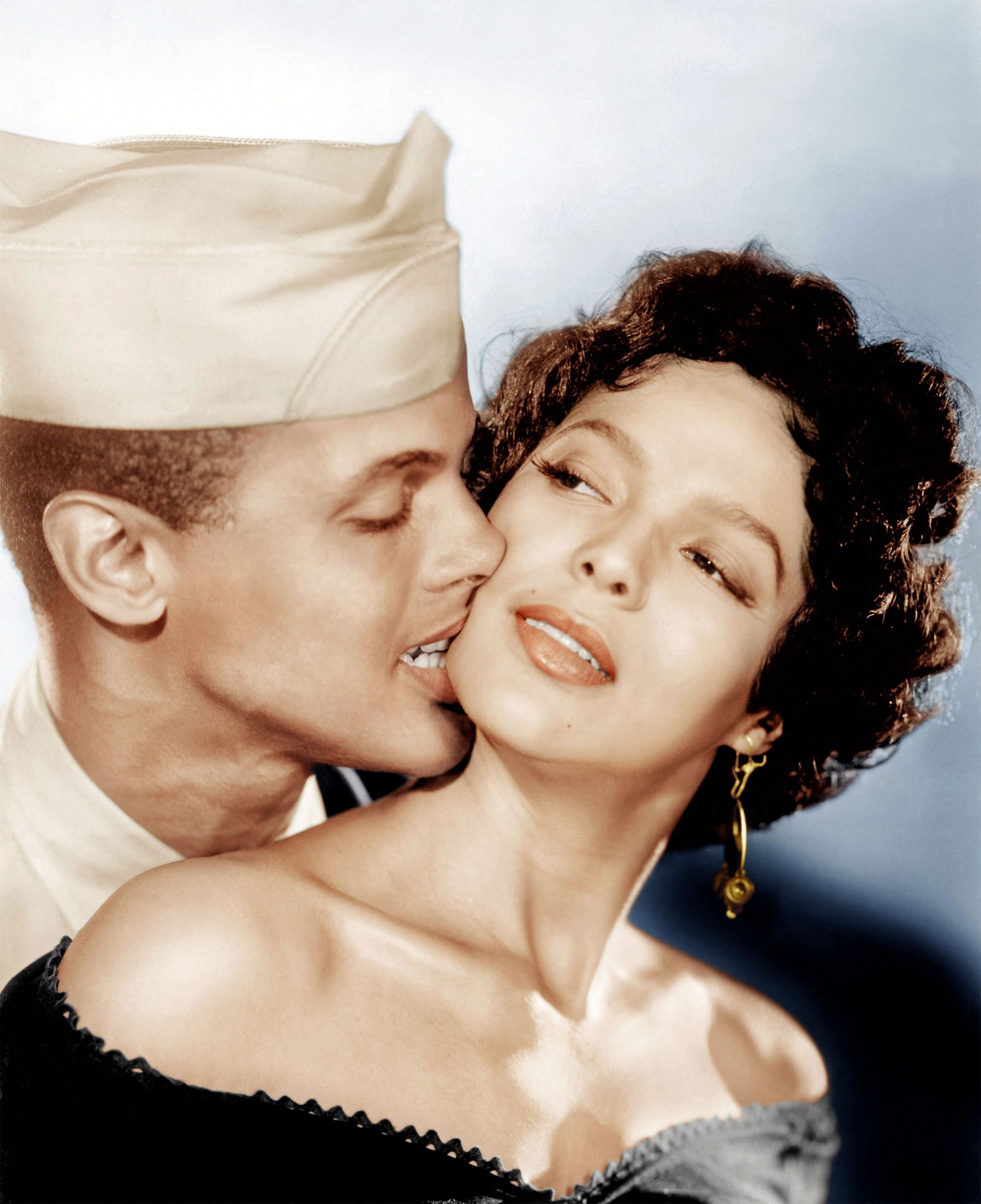
Harry Belafonte and Dorothy Dandridge starring in Carmen Jones, 1954.
Courtesy of Pictorial Press Ltd / AlamyBelafonte’s first idea for how to fill his 20-minute segment was with a folk-blues story built around John Henry, the rail-splitting giant of Negro folklore. But in discussing his plans for the show with his friend Bill Attaway—a writer at NBC with whom Belafonte had briefly run a burger joint in the Village called the Sage, frequented by the neighborhood’s folkies—another idea emerged: Why not present a musical theme with Caribbean flavor? Attaway enlisted a New York–based calypso composer named Irving Burgie to help, and they worked with Belafonte to conceive a segment called “Holiday in Trinidad.” The show aired on October 2, 1955. The Comedy Hour’s host, Jack Carson, played the role of an island-hopping tourist who stops off in Trinidad to see Belafonte perform some tunes. Among those numbers, which Irving Burgie adapted from Jamaican and Trinidadian folk sources, were “Hosanna,” “Come Back Liza,” and “The Banana Boat Song” (or “Day-O,” as it was then known)—Belafonte’s first public performance of his most famous number. The show didn’t get great ratings. But it did give its star the material for his next LP.
The Artists-and-Repertory men at RCA were dubious. But Belafonte, who’d added these tunes to his stage set alongside a calypso called “Matilda” that his audiences loved, was adamant. And one night at dinner, he won the support of the label’s boss. George Marek’s call was in some ways a bold one. But it was also of a piece with the RCA executive’s larger effort to figure out how best to exploit the LP format at a time when other advances in recording and playback fidelity were making listening an ever more wondrous experience. It was an era whose booming consumer economy joined with new technologies—including the incipient rise of multitrack recording and stereophonic sound—to change fundamentally how music circulated in the culture.
The LP, which first appeared in 1948, allowed for capturing and playing back longer songs and symphonies, and extended solos on jazz records. It also forged the modern concept of the “album” with which we’re familiar today: as a linked suite of songs offering a coherent artistic statement by their creator. In the 1960s, college kids would become the great consumers of long-playing rock albums; in the LP’s early days, young people stuck to feeding dimes into jukeboxes and buying 45s. The new format’s primary consumers were the parents of ’60s hippies: those “greatest generation” denizens of new postwar suburbs who bought newfangled hi-fi equipment for their Levittown living rooms, and were newly in the market for recorded accompaniment to their cocktail parties or romantic evenings by the fire.
At first this market was dominated by Broadway cast recordings like South Pacific—a hit that remained the top-selling album in America throughout 1949, 1950, and 1951. Soon enough, though, cast recordings were joined by records explicitly aimed at providing sonic wallpaper for those suburban “dens.” Crooners like Perry Como and Johnny Mathis ruled the roost; Paul Weston launched an eponymous genre with his hit Mood Music LP in 1953; and the television comic Jackie Gleason had that year’s top-selling album with Music for Lovers Only. With mood music’s emergence also came that of “exotica.” If the aim of mood music was to forge a particular atmosphere in its listeners’ homes—cozy, nostalgic, sexy—its close cousin aimed to bring distant parts of the world into those same spaces.
Exotica’s great purveyor, the Hollywood bandleader Les Baxter, scored 1951’s #3 seller with Voice of the Xtabay, recorded with Yma Sumac’s Inca orchestra. “Do the mysteries of native rituals intrigue you?” asked the liner notes to his other 1951 effort, Ritual of the Savage. “Does the haunting beat of savage drums fascinate you? . . . This original and exotic music by Les Baxter was conceived by blending his creative ideas with the ritualistic melodies and seductive rhythms of the natives of distant jungles and tropical ports to capture all the color and fervor so expressive of the emotions of these people.” Belafonte’s political and artistic aims may have diverged radically from Baxter’s. But by the time he made Calypso, the idea of evoking a foreign, exotic world over the course of a whole LP wasn’t new. What was novel was perhaps Belafonte’s essential advantage—that he didn’t need to hire Inca princesses to lend his albums their “exotic” tinge: he could embody it himself. As a folk singer, Harry had sung material from around the world from the start: his first RCA single to chart, in 1953, was a Japanese love song called “Gomen Nasai.” And now he wanted to record a full album of songs from the foreign region he knew best.
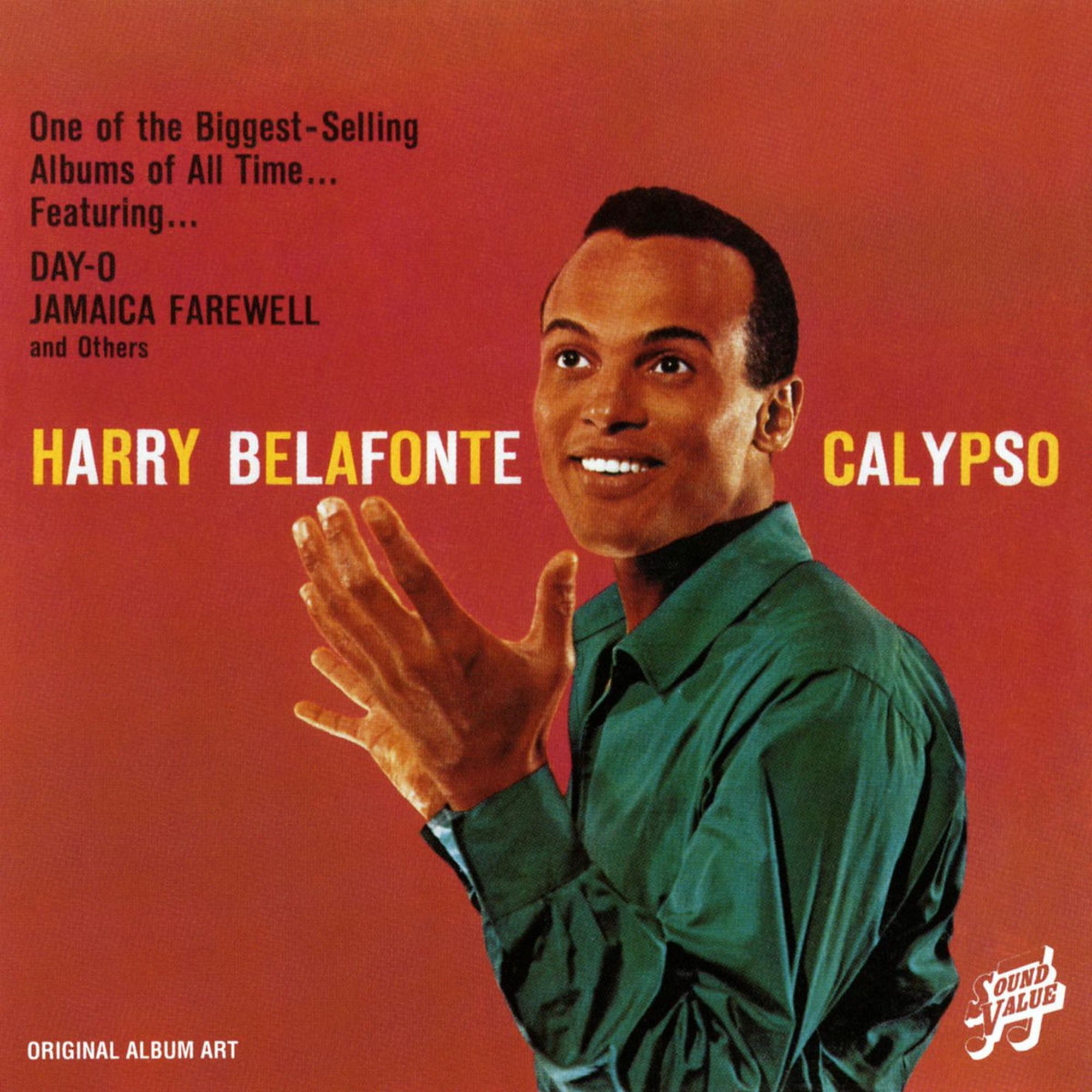
Album cover for Harry Belafonte's Calypso, 1956.
The RCA honcho who embraced his pitch, George Marek, was a Vienna-born Jew who’d emigrated to New York in his teens. He’d gotten his start in the record business seeking to popularize Old World art music for U.S. listeners. First as music editor at Good Housekeeping and later as chief of A&R at RCA, he’d released such records as Classical Music for People Who Hate Classical Music and penned books like A Front Seat at the Opera. Classical music was his passion, but Marek was a proselytizer for the sonic arts in general, with a keen marketer’s mind. He’d overseen RCA’s mood music series and initiated the label’s shift to packaging its records in colorful dust jackets and selling them in drugstores and supermarkets. Getting customers hooked on “music, any kind of music” was to be the record man’s aim. “As the cigarette people believe,’’ he said, ‘‘the habit is everything.’’ Marek’s ambit at corporate RCA was far different from that of famously uncommercial impresarios who’d fostered the Village folk scene like Moe Asch of Folkways Records. But George Marek’s interest in what Belafonte had to say about Caribbean music went much deeper than the profit motive. “He was very much an intellectual,” Belafonte would recall of that dinner with a professional colleague he came to cherish, “hugely sensitive to oppression. He loved culture, and he was very open toward all kinds of music.”
Marek’s openness, in the event, enabled Belafonte to release his most popular record—and augured what made its triumph historic. Calypso would prove, to Marek’s fellow executives at RCA and the culture at large, that as Belafonte later put it, “Americans were more ready than had been assumed to hear the voices of others or the culture of other people.”
*
No one knows how to make a hit record. That’s an industry truism with which pop savants like Taylor Swift and Ed Sheeran may disagree. So might purveyors, nowadays, of dance hits and boy-band bait concocted with algorithmic precision to inflame the dopamine receptors of preteens. But every record-business veteran has had the experience of seeing a record they thought to be brilliant flop in the marketplace—and of being surprised by what takes flight. As Quincy Jones said of producing Michael Jackson’s Thriller in the 1980s, “If anyone tells you they know how to sell 60 million copies, they don’t. You do something that you love and that gives you goose bumps. It works out or it doesn’t.” No one, in other words, can legislate for the kind of supernova success enjoyed by an album like Thriller. And the same was certainly true of its historic forebear, in the annals of LPs that became cultural touchstones, that Belafonte set out to record in October 1955. Neither he nor his collaborators knew what was in store when they turned up at a storied concert hall on East 11th Street—Webster Hall—that RCA’s engineers had recently outfitted as a capacious studio for recording their biggest projects and stars.
Calypso was recorded the same fall that his Colgate segment aired on NBC. It was released the following May, while his previous LP, Belafonte, was also still riding high on the charts. The new album, buoyed by its breakout singles “Banana Boat (Day-O)” and “Jamaica Farewell,” sold fast. By summer’s end, it had bested Elvis Presley’s own sophomore album for RCA to top Billboard’s charts—and would retain that spot, on its way to becoming the first LP by a solo artist to sell a million copies, for no fewer than 31 weeks. It stayed on the charts for 137 weeks—a mark not surpassed until Thriller came along three decades later. But it got its start in Manhattan’s East Village, near the clubs where Harry’s musical career had taken flight a few years before, and in a vaunted space that RCA acquired, in 1953, as a kind of acoustical annex to the company’s main recording studio in the city on 24th Street.
Webster Hall’s story began in 1886, when a Polish-born German Jew opened a grand new “hall for hire” near the northern end of Kleindeutschland—the sprawling enclave of German speakers that thrived across what’s now Manhattan’s Lower East Side. Charles Goldstein’s place was built in a Renaissance Revival style. It had an ornate mansard roof and brick facade accented with terra-cotta cherubs and was intended, reported The New York Times, “for balls, receptions, Hebrew weddings, and sociables.” It also hosted working-class members of new immigrant groups, and revelers and radicals of all stripes. After the tragic Triangle Shirtwaist Factory fire killed 146 seamstresses a few blocks away, it is where the Amalgamated Clothing Workers of America was founded in 1914. Webster Hall is also where Emma Goldman propounded anarchism and birth control to insist that women had “the right to beautiful, radiant things,” and where the socialist magazine The Masses staged masquerade balls. During Prohibition, drag fetes and outré bacchanals filled this “Devil’s Playhouse,” which also played host, at Prohibition’s end and for a more upmarket set, to an epic party called The Return of John Barleycorn.
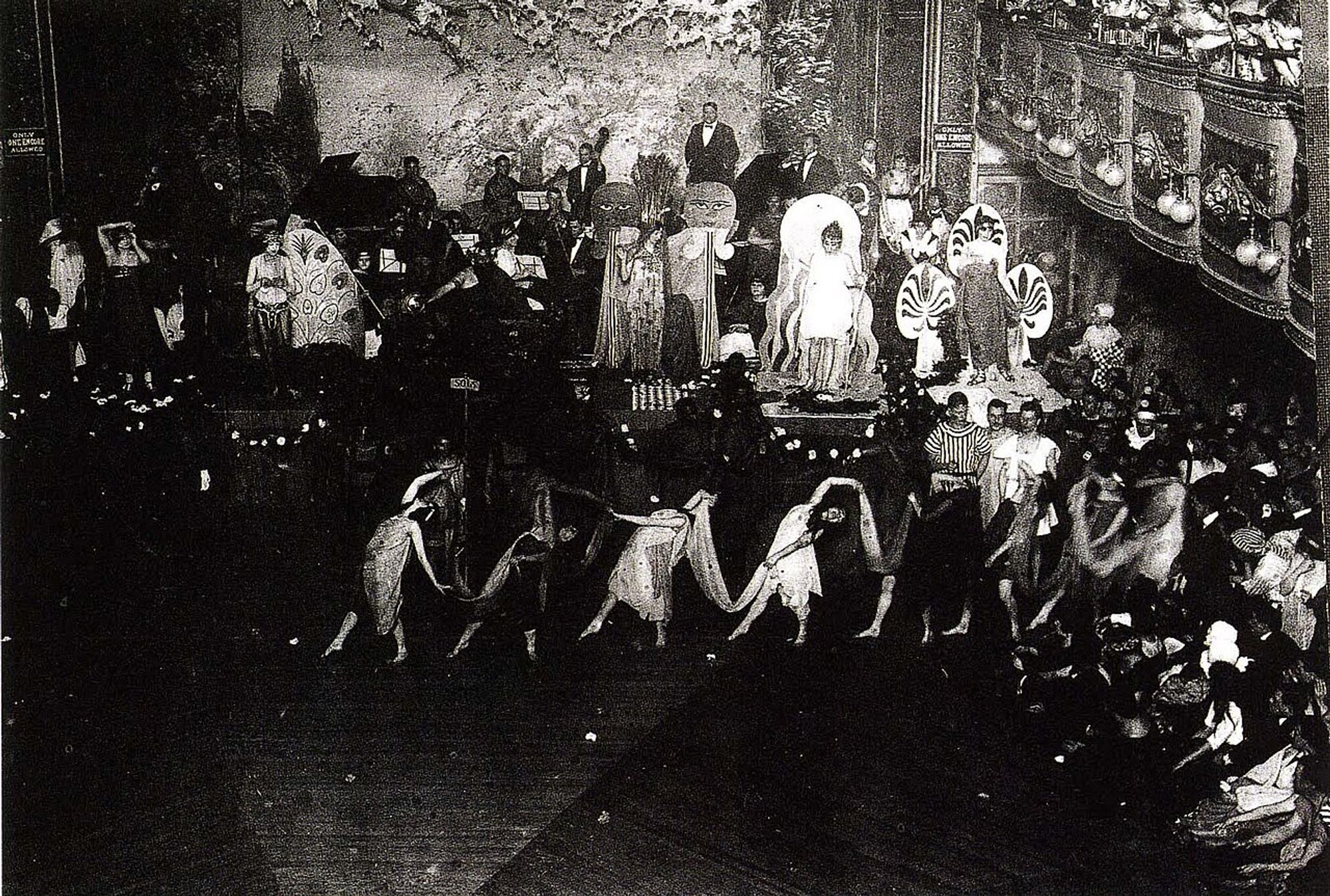
Drag Ball at Webster Hall, 1920s.
Courtesy of Wikimedia CommonsAfter World War II, the place became home to heroes of Latin music like Tito Puente and Tito Rodriguez, who turned its dance floor into a vital seedbed for New York’s mania for mambo. Woody Guthrie and Pete Seeger hosted hootenannies that became integral to the founding of Sing Out! magazine, in 1950, and to the folk revival at large. But what most drew RCA’s engineers to the high-ceilinged space were acoustics at once reverberant and clear, which helped anything recorded at Webster Hall sound like sitting mid-orchestra at a Broadway show. Among the original cast recordings made here between 1953 and 1969, when RCA sold the place to open a new suite of studios at its uptown offices, were favorites including Fiddler on the Roof and Carol Channing’s Hello, Dolly! This is where Elvis came to record “Hound Dog” in July 1956. And anyone lucky enough to happen into the place the fall before, on the afternoon of October 20, 1955, would have witnessed one of the most beloved vocal performances in the history of pop.
To deliver it, Harry riffed on the lyric to a Jamaican work song around which he and Bill Attaway had also built his Colgate Comedy Hour segment. He stepped back from his mic’s metal grille to let his voice travel a little ways, through Webster Hall’s echoing air, before hitting its diaphragm. He began this new record—the first seconds of what became Calypso’s first track—with a trick he’d picked up in Las Vegas of grabbing a crowd’s attention with an a cappella cry: “Daaaaay O!” The words voiced the relief with which island stevedores, who loaded banana boats at night to avoid the sun’s heat, met the arrival of daylight that let them go home. They might have been addressed to the unionists who’d once packed Webster Hall or the flappers who danced there until dawn, resounding as they did with a sense of a greater workers’ history. Seven decades later, they still echo across our sports arenas and in the culture at large:
“Daaaaay O! Day-ay-ay O! Daylight come and me wan’ go home . . .”
*
Audiophiles and casual fans alike have marveled at this record’s quality and wondered at the vibrating clarity of Harry’s voice. In truth its reverb was simply in the effects of Webster Hall, as captured by RCA’s engineers with the help of what the company touted as a “New Orthophonic High Fidelity Recording.” RCA had been using this mode of electronic recording ever since acquiring the Victor Talking Machine Company in 1929. But new state-of-the-art microphones and precision cutting heads now allowed its engineers to transfer what those microphones captured to lacquer grooves with more fidelity than ever before. Such was the alchemical technology by which the sounds aired here would reach people’s hi-fis at home. But as with all creative projects that grow bigger than the sum of their parts, the ideas and forces that gathered in Webster Hall for the Calypso sessions (the October date was preceded by an earlier one on August 18, and followed by a final session on November 9) were the product of both accident and intention. Calypso was a collaboration with a larger cast of characters, drawn from the now-28-year-old singer’s decade-long career in the performing arts. They all brought key ingredients to a record conceived as an “integrated trip through the West Indies,” as Bill Attaway put it in his liner notes, with “songs ranging in mood from brassy gaiety to wistful sadness, from tender love to heroic largeness.” The organic-yet-orchestral timbre of the finished tracks—drawn from folk sources and mixed to an impeccable sheen—was created by a group of musicians convened by Harry’s bandleader Tony Scott, another close friend from the Sage days.
Scott was born Anthony Sciacca in New Jersey: he was an Italian American drawn to Black music who used his chops on clarinet and a network of leading jazzmen, as he later told DownBeat magazine, to lend Belafonte’s folk records a “jazz feeling.” Among those Scott summoned to Webster Hall, alongside Harry’s longtime accompanist Millard Thomas on guitar, were the brilliant jazz bassist Milt Hinton and drummer James “Osie” Johnson. Also present were a chorus of Broadway actors led by Brock Peters, who’d sung Belafonte’s parts inCarmen Jones; Frantz Casseus, the Brooklyn-based “father of classical Haitian guitar” (and contributor of “Merci Bon Dieu” to Harry’s repertoire); and Herman Diaz, Jr., the Puerto Rican session leader responsible for moving the drums on “Day-O” closer to the room’s mics to make them more prominent in the mix. Perhaps most notable of all was Irving Burgie, who wrote—or, more accurately, adapted from folk sources—the songs that became Belafonte’s most iconic hits.
Burgie was born in Brooklyn to a Barbadian mother and a Black American father: he was a fellow New Yorker with West Indian roots, and a gifted songwriter who shared Belafonte’s affinity for turning folk music from the islands into northern pop. After the war, Burgie had used his own GI Bill funds to study classical voice and composition at Juilliard. He’d knocked around the same circuit of folk clubs and union-sponsored hootenannies Belafonte plied in the late ’40s with the likes of Pete Seeger. And then Burgie built an encyclopedic knowledge of folk songs from across the West Indies—mentos from Jamaica, merengues from Santo Domingo, calypsos from Trinidad—and a healthy store of ballads and love songs, always island-tinged, that he wrote himself.
Burgie was short and unassuming in aspect; he was never destined to break out as a performer. But in 1954 at the Village Vanguard, he convened a group of Caribbean musicians—among them Haitians and Afro-Cubans and a Jamaican piano and penny whistle player, Herb Levy, who would also join Belafonte’s Calypso sessions—that the club’s owner, Max Gordon, dubbed Lord Burgess and the Sun Islanders. Thus did Burgie, now also known as Lord Burgess, gain a sobriquet that recalled the regal monikers of calypso’s mighty makers in Trinidad, the British island in the southern Caribbean where the form was born. Never mind that “Lord Burgess” had never matched wits or lyrics with calypsonians there who battled for supremacy, with their songs, to be crowned monarch of Trinidad’s famed yearly carnival.
This borrowing of the customs and vibe of calypso’s home island—a place neither Belafonte nor Burgie had visited in 1956—was in keeping with their project’s gestalt. Notwithstanding its title, only two songs on Calypso were in fact calypsos—“Brown Skin Girl” and “Man Smart (Woman Smarter),” both by a vaunted Trinidadian composer named King Radio but miscredited here. Of the album’s other nine songs, Burgie received a writing credit for eight. Alongside his originals like “I Do Adore Her” and “Dolly Dawn,” these were mostly mentos and folk songs from Jamaica whose lyrics or melodies Burgie tweaked for a new frame. He’d learned a few of them, including Calypso’s breakout hit, from fellow denizens of the Village Vanguard—which is where, in or around 1953, he and Harry both met the great Jamaican folklorist and singer Louise Bennett.
“Miss Lou,” as Bennett was affectionately known, became a national hero in Jamaica who did more than anyone to convince her people that the richness of their own oral culture—from the patois they spoke to the Anansi stories they told and folk songs they sang—held as much value as any book published in Oxford English. During a stint in New York in the early ’50s, she wrote plays but also worked as a cashier at Macy’s—which is where she met Harry’s friend Tony Schwartz, an agoraphobic connoisseur of what came to be called world music who obsessively recorded the sounds of his home neighborhood in midtown. After hearing Bennett sing at Macy’s, Schwartz introduced her to Belafonte and Burgie and then helped her record an album for Moe Asch on Folkways. Called Jamaican Folk Songs, it included a recording of “Day Dah Light” that beat Belafonte’s version to the punch by two years (as did another version, by the Trinidad-born singer and actor Edric Connor—who in 1956 made a star turn, as Daggoo the harpooner, in Gregory Peck’s 1956 film version of Moby Dick).
Irving Burgie, in adapting the folk version recorded by Bennett and Connor for American ears, retained enough of the original Jamaican lines to keep its island feel. He replaced certain of its denser patois lyrics with plainer English, and made one odd change: where the old work song referenced counting banana “hands”—as bunches of the fruit are logically called—his lyric invoked another appendage (“Six foot, seven foot, eight foot bunch!”). But tweaks to language aside, what most distinguished his version from Miss Lou’s was how Harry’s was arranged and performed. Miss Lou’s “Day Dah Light” hewed near to renditions sung by workmen to keep themselves trudging up Jamaica’s docks onto bananaboats like those owned by the United Fruit Company, the firm for which Harry’s father worked as a cook and whose vessels Harry also boarded as a boy. Her voice’s up-tempo lilt, accompanied by little more than hand drums, is more plea than demand. Summoning the tallyman is a lament, in her tuneful staccato, redolent of what Bill Attaway described as “the irrepressible rhythm of a people who have not lost the ability to laugh at themselves.” Harry’s slowed-down version, on Calypso, is different. It’s vested with as much pathos and drama as his voice could wrest from a feeling—as daylight comes, he wants to go home—that here becomes a demand indeed. Harry may have been capable, on occasion, of self-deprecation, but in truth he was never much given to laughing at himself, let alone at his people. And he didn’t do so in the number here rechristened “Day-O” and also released as “The Banana Boat Song.”
His initial cry grabs our attention. Then his lush vocal drifts toward us as if from down the beach, drawing closer. He riffs on the word he’s insisting we hear: “Me say day-ay-ay-O.” He descends a note with each line, as if striding downstairs, and then steps down quicker. We’ve hit the bottom of his range. His voice is still warm and full. He exhales the reason we’re here—daylight’s come, he wants to go home—with a last extended “O.” We’re ready, now, for this dynamic preamble to end. We’re ready for the song to begin in earnest, with a rhythm set by the next line—he’s worked all night, he wants to drink a rum—that the chorus and drums hit just as the rum does. Voices gather around Harry’s. They keep time with the congas’ steady march. They reply to his rum line with the refrain they’ll repeat, about wanting to go home, for the rest of this song about stacking bananas till morning comes. And so it goes as the tallyman arrives and the black tarantula does, too—before this tired singer and his cohort of harmonizing friends and a conga that sounds like rain eases off down the beach.
Harry’s slowed-down version, on Calypso, is different. It’s vested with as much pathos and drama as his voice could wrest from a feeling—as daylight comes, he wants to go home—that here becomes a demand indeed.
We feel, as the record ends, the exhaustion of ending a workday at dawn—the weary yet insistent note that greeting the sun’s rise entails. But part of the magic of records that resonate for as many people as this one did, is their power to do so in ways that vary across context and time. Harry turned a workman’s lament into a prideful demand. When “Day-O” echoes as a sing-along chant across Yankee Stadium today, it sounds more like a taunt—a clip of familiar Americana that underscores to the opposing team that the home side’s winning—the same sentiment as Ray Charles’s “Hit the Road Jack.” But such novelty uses, to Harry’s mind, didn’t change what the song was about. Nor did the infectious hit that the rapper Lil Wayne scored in 2011, “Six Foot Seven Foot,” that sampled its chorus. Decades after his signature tune’s release, Harry said, it didn’t belong to him any more than it did to Lil Wayne. “Day-O” belonged to working people in the Caribbean with whom it was born. He was just glad to see a new generation embrace “a song about struggle, about black people in a colonized life doing the most grueling work.” This, he told Gwen Ifill in a 2011 interview on PBS News Hour, is what made him proud. “I took that song and honed it into an anthem that the world loved.” ♦
Excerpted from DAYLIGHT COME: HARRY BELAFONTE AND THE WORLD HE MADE by Joshua Jelly-Schapiro. Copyright © 2026 by Joshua Jelly-Schapiro. Excerpted by permission of Penguin Press, a division of Penguin Random House. All rights reserved. No part of this excerpt may be reproduced or reprinted without permission in writing from the publisher.
Subscribe to Broadcast